1. What and when was the Industrial Revolution?
The Industrial Revolution was a period from 1750-1850. It was a time when agriculture, manufacturing, mining, transportation and technology began to change. It began in the United Kingdom then slowly started to spread throught Western Europe, North America, Japan and eventually the rest of the world.
Both paintings featured on this blog, that are from the early 1900s were painted by Modernist painters from the group called 'Futurists'. The Futurists celebrated the machine, and objects in motion. Their primary objective was to depict movement, which they saw as symbolic of their commitment to the dynamic forward thrust of the 20th century.
2. Research both Modernist paintings in order to comment on the subject matter, form and style used to celebrate the machine and motion in each painting. Answer the question in 2 parts for each painting.
"The city Rises" By Boccioni (1910)
This painting displays horses, workers and a construction site within the painting. The painting is very hectic and shows how the industrial revolution was a time where it was very confusing and caused alot of problems. In this painting there is a moving horse which is trying to be controlled by some workers. It is as though Boccioni is trying to show that the industrial revolution was not only effecting people it was effecting animals also. Cars were being introduced and it looks as though the horse was going crazy and getting many frights from what was going on around him.
"Dynamism of a dog on a leash" by Balla (1912)
This painting is of a dog and a ladies legs moving. It looks very blurred because the subject matter is running. This painting shows alot of movement which makes the lady and the dog look like freaks with 8 legs and 12 feet. The painting relates to the industrial revolution because it is as though the woman and the dog are trying to run away from the stress and confusion of whats going on that their feet cant even keep up with themselves.
Cao Fei's RMB City (2007-9) refers to China's recent rapid industialisation and urbanization.
(www.artspace.org.nz/exhibitions/2009/cafeintopia.asp)
3. Research Cao Fei's RMB City (2007-9) in order to comment on this work in more depth.
i.e describe the images that has she used in her digital collage that refer to China's present and history, and explain why has she used these images.
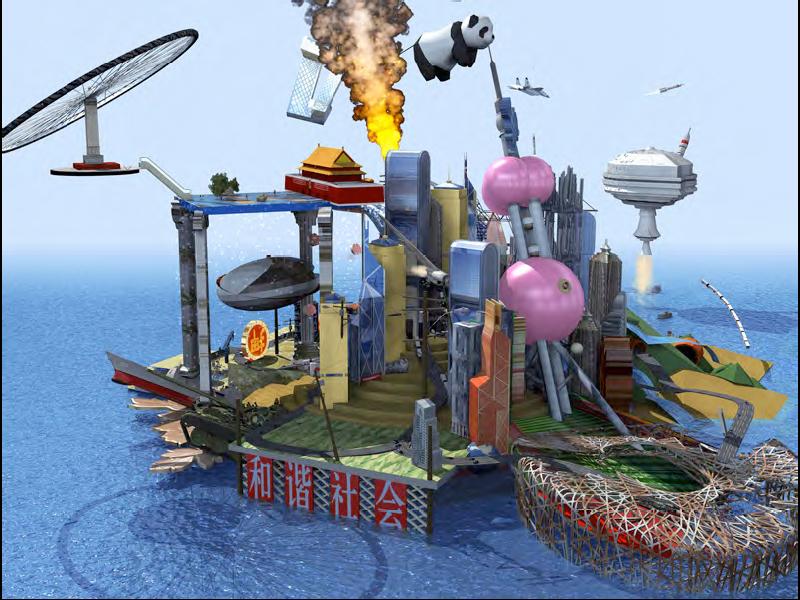
RMB City was created by Cao Fei's online indentity China Tracy on the creative commons island of Kula. RMB City shows a view of Beijing and the mix of communism, socialism, and capitalism. Beijing is always under construction, smoke escapes into the sky, and ships are always moving into the port. A giant shopping cart filled with skyscrapers floats nerby, and Tiananmen Square has been changed into a swimming pool. This work used Beijing as an example of what the industrial revolution was like showing how quickly things change and how hectic it is to be aorund.
4. RMB City is described as a utopia/dystopia. Comment on what these terms mean, and how they can be applied to the work.
An online definition states that utopia was "An imagined place or state of things in which everything is perfect." and that dystopia was "An imagined place or state in which everything is unpleasant or bad, typically a totalitarian or environmentally degraded one." The term utopia can be applied to the peice of work because the work was made on the computer and has a 3D online effect. This shows the imagination coming through to create this peice of work. Although utopia means where everything is perfect is clearly was not in this case. This is where dystopia comes in, this work shows how the industrial revolution was ruining the environment such as Beijing constantly is.
5. Although the Modernist paintings and the contemporary digital work have emerged from
different contexts, there are also many similarities. Comment on the similarities that you can see in the work. Look at the moving digital image at vimeo.com/4272260, if you have not
already researched it.
They both relate because it is clear that the industrial revolution was a big change and caused alot of issues in the beggining. One similaritie would be the atmosphere. The atmosphere in these works doesnt look very warming or comfortable it looks rushed and feels asthough it would have been a very hard time for humans at this time. Also the movement within the images is similar. Its very out of control.
6. Comment on other student's blogs.


